Innovative Video Motion Control Tech: A New Era for Agencies and Brands
What motion control changes for tabletop video
A robotic camera move sounds like overkill until you've tried to repeat a splash shot for the twentieth take. Here's what motion control actually is, what it changes for tabletop work, and where it's worth the setup time.
Motion control isn't new. It's been in feature film and high-end commercials for decades — the original Star Wars dogfights used it back in 1977. What's new is how often it shows up in tabletop work: the food, drinks and product side of advertising where the camera move is millimetres rather than metres. The rig itself hasn't changed much. The reason it matters in tabletop is that the camera path has to be precise to the millimetre, and the things happening in front of the camera — a pour, a splash, a product reveal — have to land on the same frame every time.
What motion control actually is
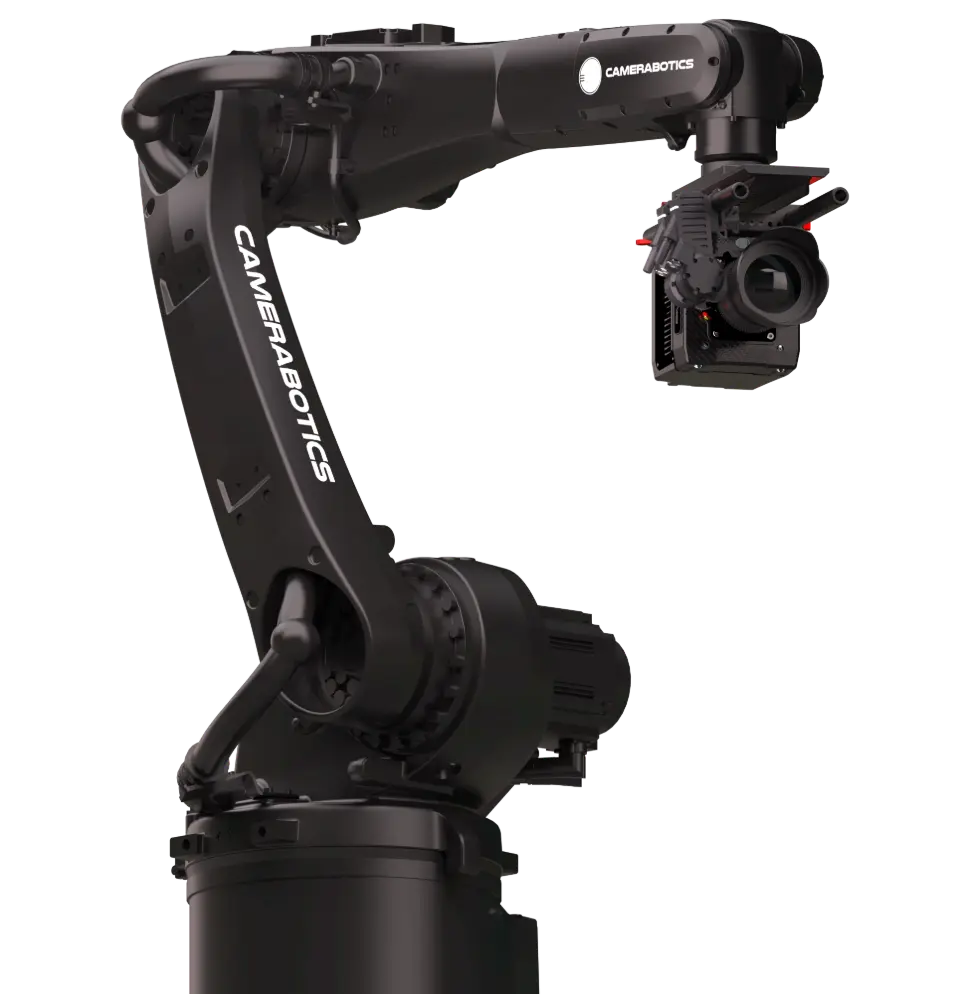
A robotic arm with the camera on the end of it, moving along a path that's been programmed in advance. The rig records the move and can replay it exactly — same speed, same height, same arc — for as many takes as the shoot needs. Our rig, a Camerabotics CRX1440, has a 1,440 mm reach, takes an 11 kg payload, hits 3 m/s at peak and repeats positions to ±0.04 mm. The arm is compact enough to roll through standard doors and lifts, so it travels on location rather than living in one studio.
What changes when the camera moves the same way every time
Three things. First, multi-pass composites become straightforward. One pass for the product, one for the splash, one for the lighting accent — all stacked on the exact same camera path in post, no rotoscoping the misalignment out. Second, the timing of effects locks to the camera position. When a drop falls or a liquid pours, the rig can trigger the effect at the same frame on every take, so the shot can be refined and re-shot identically until the lighting and the move and the moment of the splash all line up. Third, the shot can be planned. The director sees the move in pre-vis, the team builds the rigging around it, and the production day stops being a hunt for the take that just happens to work.
What we use it for
Mostly the shots where the move matters as much as the lighting:
- Splash shots and timed liquid pours
- Ingredient bursts, drops and arcs
- Spinning, floating or rising product reveals
- Stop-motion-style consistent-angle tracking
- Multi-pass composites where every pass has to register
The motion control rig usually doesn't work alone. It's paired with effects rigs — droppers, turntables, conveyor belts, launch tables, product rotators — that move the thing in front of the camera in sync with the camera move. The rig moves; the effects rig fires; our 8K RED V Raptor or S5K Freefly Ember high-speed camera records. The whole thing runs as one choreography.
What it doesn't replace
Motion control is a tool, not a magic wand. The rig is slower to set up than a handheld shot — the path has to be planned, the markers placed, the timing rehearsed. Not every shot benefits from it. A clean front-lit packshot doesn't need a robotic move. A spontaneous handheld feel will fight the rig the whole way. And the rig doesn't replace lighting, art direction, set design or the people running them. It replaces the manual operator on the moves that have to be precise.
On the operator point: our rig always ships with one of our motion control operators. It's not gear we hand over and walk away from. The reason isn't policy — it's that running this rig well, particularly synced with effects rigs and high-speed capture, takes more setup judgement than a rental sheet can cover.
Where this fits
We've leaned into motion control because it complements the kind of tabletop work we already do — food, drinks, product, the close-in advertising imagery where the difference between a good take and a great take is usually a few millimetres and a few frames. It's also part of the same argument as our recent piece on real footage versus AI-generated imagery — that controlled, repeatable, intentional craft is what makes advertising imagery feel deliberate at every frame. Different tools, same philosophy.
If you're planning a project where motion control might be the right call, the page that covers how we work with it commercially is [/motion-control](/motion-control) — full-service production or specialist operator team, depending on how your project is set up.